Request Appointment
Enter your details and we will be in touch with you shortly;
Or call
8655885566
between 8 am and 8 pm.


Scoliosis is an abnormal sideways curvature of the spine that appears in an “S” or “C” shape. This curvature may be structural (fixed changes in the spine) or functional (related to posture or muscle imbalance).
Studies show that scoliosis is more common in females than in males, and progression of the curve is also more frequently observed in women.
Scoliosis can develop when there is excessive tension or stretch on the spinal cord. In response to this tension, the spine may begin to coil in order to reduce the distance between the skull and the sacrum. If the tension continues, the spine may curve further until the stress is relieved. Over time, this adaptive response can result in a visible spinal curvature known as scoliosis.
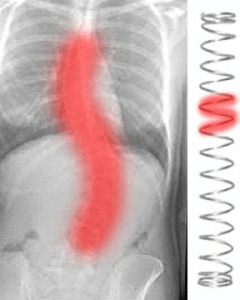
Scoliosis progression can broadly be classified into rapidly progressing scoliosis and gradually progressing scoliosis.
Rapid progression is primarily influenced by hormonal changes and commonly occurs during key stages in a woman’s life:
Puberty is a time of sudden growth which itself acts as an additional stressor for the advancement of the curve. Research had found direct link between the progression of scoliosis and the available growth potential in the individual. In simpler terms, if the growth period is still not over there are more chances of the curve to progress.
During pregnancy, due to biomechanical changes the centre of gravity is constantly changing. Additionally, the hormone Relaxin, cause all the ligamentous structures of the body to become lax. So if a women is not doing exercises that will build up the muscles to support her spine it can cause further deterioration of the scoliotic curve.
Menopause causes demineralization of bones due to hormonal imbalances. This can result in osteopenia and osteoporosis in bony structures. As a result of this the scoliosis can increase.
Gradual scoliosis progression occurs mainly due to gravitational forces acting on an imbalanced spine. Changes in spinal alignment can cause muscles on one side to become overstretched while the opposite side becomes shortened. These muscular imbalances reduce the spine’s ability to support itself efficiently, especially when movements occur away from the body’s midline.
Every scoliotic curve is unique, which is why a personalized exercise program is essential. A well-designed rehabilitation plan can help:
Depending on the individual’s condition, additional support such as bracing, customized orthotics, or specialized footwear may be recommended. Consulting a spine specialist is crucial to ensure accurate assessment and appropriate treatment.
Visit our nearest clinic for your first consultation