Request Appointment
Enter your details and we will be in touch with you shortly;
Or call
8655885566
between 8 am and 8 pm.


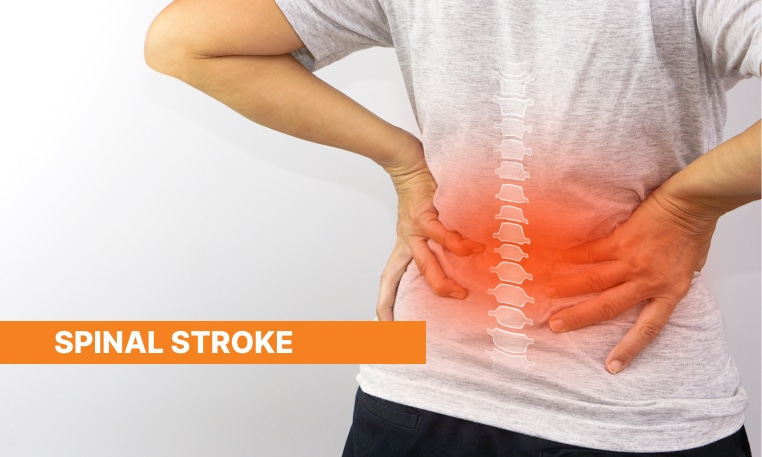
Your spinal cord, just like your brain, is a key part of your central nervous system. It needs a constant blood supply to work aptly. A spinal stroke occurs when blood can’t reach your spinal cord. Doctors also call this spinal is chemia or spinal cord infarction. It’s not common, but it’s a serious condition. It can lead to nerve-related problems and might cause major disability down the line.
A spinal stroke is a form of stroke caused due to decreased blood flow to the spinal cord. Whenever the arteries which supply the spinal cords get blocked due to a blood clot, the spinal tissues and cells get destroyed, resulting in an ischemic spinal stroke. A hemorrhagic spinal stroke occurs because of bleeding. Though very rare, it accounts for only 1 per cent of all strokes. In the event that a spinal stroke is caused, it may mean long-term complications of health, paralysis, or even at times, it can mean death when one fails to seek medical attention immediately.
Most of the spinal strokes occur due to changes in the structure of the blood vessels. For example, the blood vessel walls may thicken which may result in the blood vessel becoming narrow; often as a part of the natural aging process.
Several specific factors can significantly elevate the risk of these changes, including:
These risk factors put an extra burden on the heart to pump blood and make it a lot more probable for the blood vessels to become narrowed or are not likely to function properly. For instance, high blood pressure weakens blood vessels and makes them fragile and more vulnerable to rupture and bleeding, potentially leading to a stroke. Other less common spinal stroke causes include abnormally tangled blood vessels called arteriovenous malformations (AVMs), spinal tuberculosis, spinal cord compression, cauda equina syndrome (CES) and secondary spinal tumours. There is also an increased risk of spinal stroke after abdominal surgery.
The signs of a spinal stroke depend on what region of the spinal cord has been affected and how much of the cord has been injured. The symptoms usually appear suddenly, but sometimes they might appear a few hours after a stroke.
Common spinal stroke symptoms include:
Spinal stroke treatment is based on the precise cause of the spinal stroke, coupled with symptom severity and degree of damage.
Medication options may include:
In emergency situations, surgical intervention may be needed to remove blood clots from arteries or veins through what is called surgical thrombectomy. It involves a surgeon making an incision near the blocked vessel to extract the clot. Another approach is the insertion of a small balloon-like device that holds the vessel open to continue blood flow.
The physical and occupational therapies seem to be effective in regaining function and independence in cases of long-term muscle weakness or paralysis. If an issue arises in passing, such as difficulty passing urine, then a catheter use may be necessary. This is a flexible tube placed in the pelvic area through which one may facilitate the passage of urine and other liquids.
Complications vary based on the specific area of the spinal cord impacted. For instance, reduced blood flow to the front of the spinal cord can result in permanent paralysis of the legs.
Recovery from a spinal stroke is long and tedious. Recovery depends mainly on the extent of the primary injury and, of course, the promptness of treatment. A very important part of spinal stroke recovery is rehabilitation, which includes various therapies and other interventions. These would include the following techniques:
There are several studies that show approximately 40-42 percent of patients have an improvement in symptoms following a stroke treatment. However, how much they recover can vary a lot from person to person.
A spinal stroke is a serious medical condition that calls for urgent attention and comprehensive care. The causes, symptoms, and modes of treatment are very important for effective management. Recovery from any form of spinal stroke depends on the multidisciplinary approach to its treatment, covering the continuum from medical care to rehabilitation and counselling support. Most patients with proper treatment and adequate rehabilitation have a symptomatic and functional improvement in their quality of life.
Visit our nearest clinic for your first consultation
Yes, rehabilitation after a spinal stroke is necessary. It helps increase mobility and strength and addresses thephysical, occupational, and psychological needs of its patients, hence facilitating better recovery and improving quality of life.
Yes, one classifies spinal surgery as high-risk because of possible complications: infection, damage to nerves, blood clots, and dangers associated with anesthesia. The risk factors are characterized by the complexity of the spine itself and dangerous areas found nearby, which make complications likely if done without proper evaluation and experienced surgical teams.
A spinal stroke may be permanent, but it depends on how intensive the damage is. Some people can regain most of their functions with early intervention and prompt rehabilitation, whereas others may experience permanent paralysis or loss of sensation. Chances of partial or full recovery are better if early treatment and comprehensive rehabilitation are provided.
In the case of spinal stroke, rehabilitation is focused on re-establishing mobility, strength, and daily functioning with the aid of physical and occupational therapy. In the rehabilitation from cauda equina syndrome, treatment programs should emphasize relieving nerve compression and enhancing lower body, bowel, and bladder functions. Specialized comprehensive rehabilitation programs need to be developed for each of these.