Request Appointment
Enter your details and we will be in touch with you shortly;
Or call
8655885566
between 8 am and 8 pm.


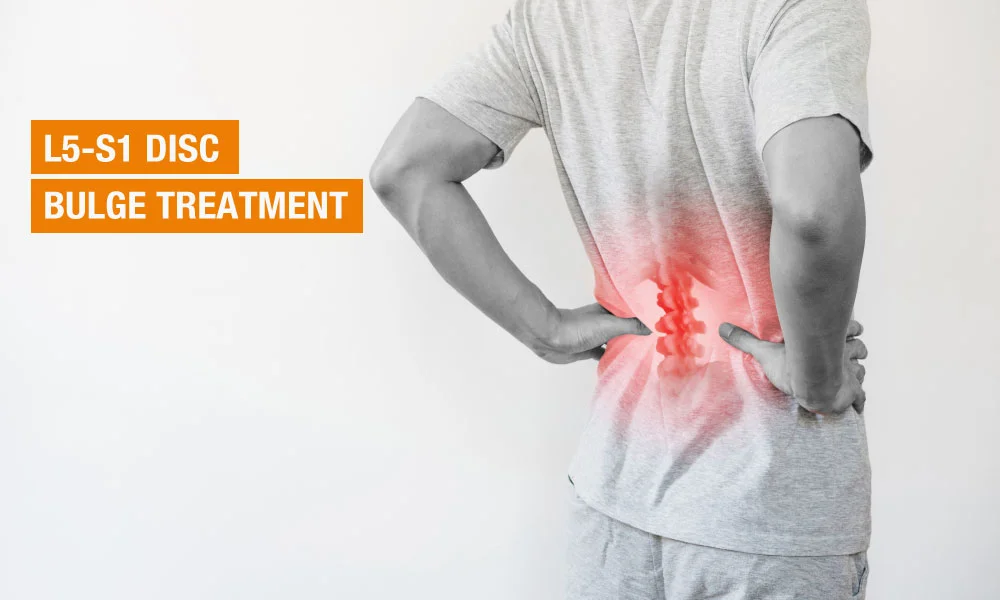
If you’ve been told you have an L5-S1 disc bulge, or you’re experiencing lower back pain and wondering what’s going on, read on to understand everything about the condition. It will give you clarity on what L5-S1 disc bulge is, what causes it, and most importantly, how to recover.
The spine consists of vertebrae separated by intervertebral discs that act as shock absorbers and provide flexibility to the spine. Each disc has two main components: a tough outer layer called the annulus fibrosus and a gel-like center called the nucleus pulposus. A disc bulge occurs when the disc extends beyond its normal boundary, typically caused by degeneration, injury, or repetitive stress.
Let’s look at the basic structure of our disc
A disc bulge happens when one of these cushions gets pushed out of place. The cushion itself stays intact, but it extends beyond where it normally should be.
| What’s different | Disc bulge | Disc herniation |
| Outer layer | Still intact | Torn or broken |
| Inner material | Stays inside | Leaks out |
| How common | Very common | Less common |
| Usually how severe | Milder | More serious |
Our spine is one of the longest organs in our body, it undergoes a lot of functions like:
Several things can lead to a L5-S1 back pain. The good news is that understanding the causes can help you prevent it or keep it from getting worse. The main causes of a disc bulge are –

Here are some common factors that could increase your risk of developing an L5 back pain problem.
Higher risk factors:
Moderate risk factors:
Jobs that can cause problems:
Listed below are some signs of L5-S1 disc bulge
Back pain:
Back pain from conditions like an L5-S1 disc bulge often comes out as a sharp, stabbing feeling or a dull, constant ache that intensifies when sitting for long periods, bending forward, or lifting objects. However, it improves when lying down or simply changing positions to relieve pressure. This discomfort frequently comes with muscle tightness and stiffness in the lower back, making movements feel restricted and adding to overall tension.
Leg pain (Called “Sciatica“):
Leg pain, commonly known as sciatica in cases like an L5-S1 disc bulge, travels from the lower back down one leg, following a specific path from the buttock through the back of the thigh, into the calf, and reaching the foot. It often feels like burning, electric shocks, or sharp shooting pain, and typically affects only one leg rather than both.
Other sensations:
Other sensations from an L5-S1 back pain often include tingling or “pins and needles” in the leg or foot, numbness where the area feels completely unresponsive to touch, and weakness in the foot or ankle. This can lead to foot dragging while walking or making it hard to stand on your tiptoes.
Diagnosing an L5-S1 disc bulge typically requires imaging after initial clinical evaluation of symptoms like back pain or sciatica.
Primary Scan: MRI
Magnetic Resonance Imaging (MRI) serves as the gold standard, clearly visualizing the bulging disc, nerve compression, and surrounding soft tissues without radiation – especially effective for the L5-S1 level where it reveals herniation extent and inflammation.
Supportive Scans
X-rays provide a quick initial view of spinal alignment, bone spurs, or instability but cannot show the disc itself; CT scans offer detailed bone and disc structure if MRI isn’t feasible, while discography (injecting dye) confirms pain sources in complex cases.
Though surgery isn’t essential for every case of spine issues like an L5-S1 back pain, it becomes an option if your pain feels unbearable after trying other treatments.
Whether you’re trying to avoid a disc bulge or prevent it from coming back, these tips will help keep your back healthy.
Keep a healthy weight
Stay active – Exercise guidelines
Follow the right sleeping position
| How you sleep | Is it good? | What to use |
| On Your Back | Best | Put pillow under knees |
| On Your Side | Good | Put pillow between knees |
| On Your Stomach | Bad | Hurts neck and back |
Choose the right mattress:
Taking rest for a longer time weakens the stabilizing muscles further and stiffens the spine. And generic core exercises like crunches or planks can aggravate the bulging disc by increasing pressure on already irritated nerves that can cause more pain, not relief. Without addressing the root instability, inflammation, or nerve compression through targeted decompression and progressive spine-specific medical movements, these approaches delay true recovery and risk chronic issues.
Here’s what typically happens to most people while undergoing L5 back pain treatment.
With non-surgical treatment:
With surgery (if needed):
Make an appointment if:
Go to emergency room If:
Call your doctor immediately, if:
QI Spine is India’s leading orthopedic-led spine care center, specializing in non-surgical treatment for all spine issues, including L5-S1 back pain. With over 22 clinics across cities like Mumbai, Delhi, Pune, and more, we use evidence-based programs backed by advanced technology to help thousands recover without surgery.
We deliver personalized L5 back pain treatment plans combining cell repair therapy, spine-specific exercises, and ergonomic-device based treatment.
We have experienced orthopedics and spine specialists who assess your exact bulge via movement tests and Digital Spine Analysis (DSA) and also suggest scans whenever required.
We also track the progress and strength of metrics for measurable results.
Reduces disc pressure: Targeted medical movements decompress the L5-S1 area, easing pain in 70-80% of patients within weeks.
Builds lasting strength: We create custom plans based on your condition to strengthen the lower back, glutes, and stabilizers to prevent recurrence.
Proven outcomes: 85% of L5-S1 patients avoid surgery, with many returning to work or sports pain-free. No surgery, no injections – just guided recovery.
Do you have any of the symptoms mentioned above for L5 S1 back pain? At QI Spine, we provide the first in-depth consultation at no cost. Call on 86558 85566, and our specialists will schedule your appointment with your nearest QI Spine center. We’ve helped over 100,000 Indians reclaim active lives – your turn could be next.
Important things to remember
Here are some key pointers one should always keep in mind, who is suffering from back pain:
Final Thoughts
Having an L5-S1 back pain can be scary and painful, but there’s really good news: most people get significantly better with simple treatments. You don’t need to become an expert in spine medicine, but understanding the basics helps you take control of your recovery.
Remember, recovery isn’t a straight line. Some days will be better than others, and that’s completely normal. Don’t get discouraged by setbacks, they’re part of the healing process.
Thousands of people deal with disc bulges every year, and the vast majority get better. The key is staying positive, following your treatment plan, and being patient with yourself. Your body has an amazing ability to heal – you just need to give it the right support.
Start with small changes today. Do one stretch. Take a short walk. Stand up from your desk and move around. These little actions add to big improvements over time.
You’re not alone, and there’s every reason to be hopeful about your recovery.
Healing time for L5-S1 disc bulge depends on the severity of the condition, but most patients improve significantly in 4-12 weeks with conservative care – milder cases can be recovered faster, and chronic ones take longer time.
You can expect initial pain relief in 2-6 weeks via rest and therapy; full strength rebuild takes 3-6 months. Consistency speeds up – 80-90% avoid surgery.
No, disc bulges often heal or stabilize naturally as the body reabsorbs material, though weakened discs need lifelong prevention to avoid recurrence.
Yes, gentle walking puts up the pressure from the disc, boosts blood circulation, and builds endurance without strain. Aim 10-20 min daily on flat surfaces once acute pain eases.
The best sleeping position for an L5-S1 disc bulge is fetal position on your side with knees bent and pillow between legs to maintain neutral spine. Avoid sleeping on the stomach, and if you sleep on the back, use knee-over-pillow support.
Rest for 2-3 days, use ice/heat alternation, consult with a doctor, and consider medical movements. Most respond here before injections or surgery.
Visit our nearest clinic for your first consultation